
When does this bloom?
July-Aug
Where does this bloom?
85-86, 167-176
Common Milkweed is also known as Butterfly flower, Silkweed, Silky Swallow-wort and Virginia Silkweed. It is a perennial plant that grows up to two meters tall. Its name originates from the white liquid that will seep from any broken section of the plant. The stem of the common milkweed is very hairy.
The broad leaves of the common milkweed have a red-colored center and a velvety underside.
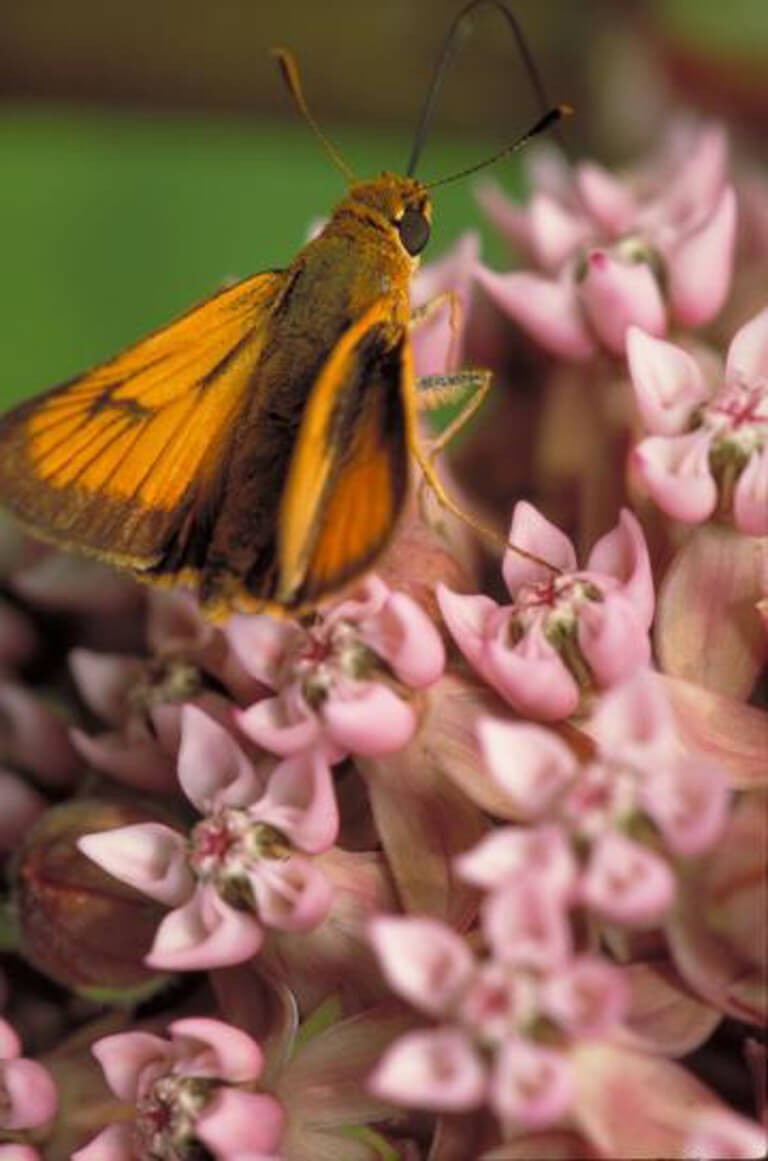
This plant’s flowers are small and grow in clusters. Each individual flower is only about 1-2 cm in diameter. The seeds attached to the long, white flossy hairs of the plant give the common milkweed its scent. This plant is known to be quite invasive and is often considered a weed.
Uses
The plant’s latex, or milky white liquid, contains large quantities of glycosides, making the leaves and pod bark toxic for if eaten by sheep. This plant can also be potentially dangerous to humans though a large quantity of the foul-tasting parts would need to be eaten. The young shoots, leaves, flower buds and immature fruit are all edible. It is still important to make sure that they are completely cooked before eating. If not, these otherwise edible plants are still toxic. Be careful not to confuse the young shoots of the common milkweed with those of the toxic Spreading Dogbane and Common Dogbane.
Failed attempts have been made to find industrial uses for the common milkweed. Both rubber (from the latex) and fiber (from the seed’s floss) were two examples. The floss of the plant however, can be used for stuffing. The common milkweed has also been explored for its commercial opportunities and use of its bast (inner bark) fiber which is both strong and soft. The U.S. Department of Agriculture conducted studies in the 1890s and 1940s that found that Milkweed has more potential for commercial processing than any other indigenous bast fiber plant. The results estimated that the quality was as good as flax and the yields could be as high as hemp. Both the bast fiber and the floss were used by Native Americans for cordage and textiles.