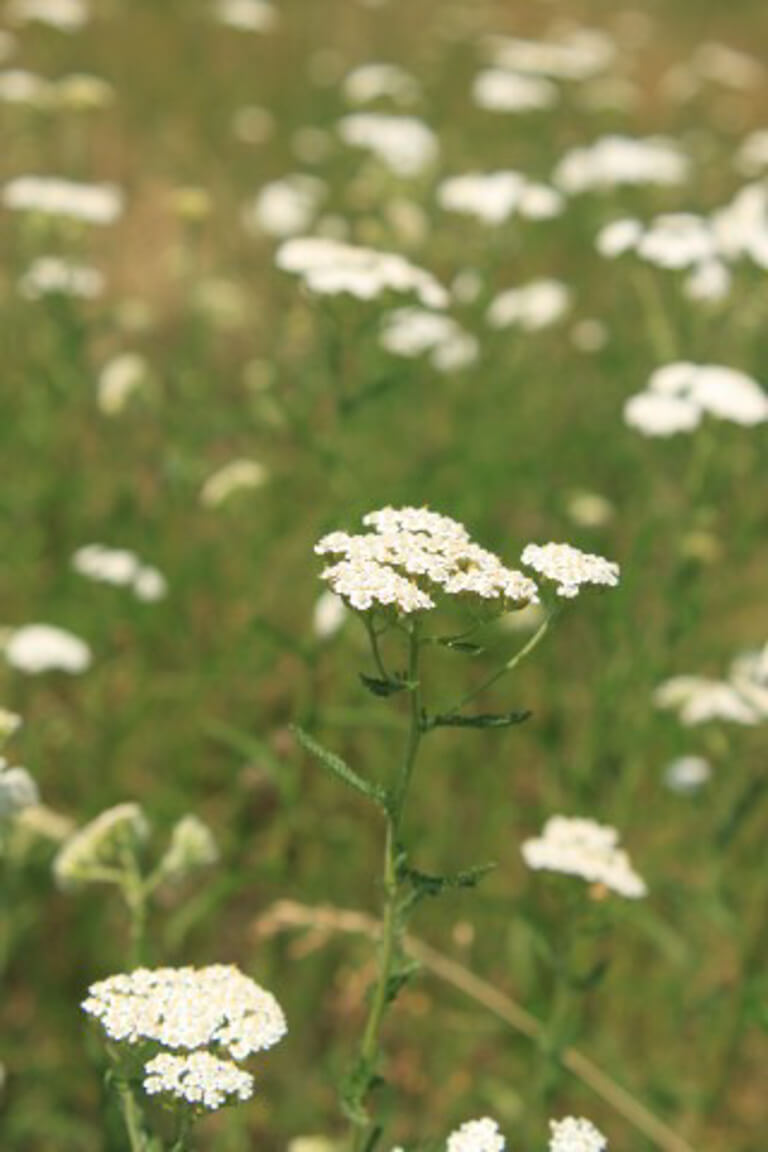

When does this bloom?
July
Where does this bloom?
Common in fields and along roadside.
Common Yarrow is an erect herbaceous perennial plant that produces one to several stems (0.2 to 1m tall) and has a rhizomatous growth form. Leaves are evenly distributed along the stem, with the leaves near the middle and bottom of the stem being the largest. The leaves have varying degrees of hairiness (pubescence). The leaves are 5-20 cm long, bipinnate or tripinnate, almost feathery, and arranged spirally on the stems. The leaves are cauline and more or less clasping.
The inflorescence has 4 to 9 phyllaries and contains ray and disk flowers which are white to pink. There are generally 3 to 8 ray flowers that are ovate to round. Disk flowers range from 15 to 40. The inflorescence is produced in a flat-topped cluster. Yarrow grows up to 3500m above sea level.
The plant commonly flowers from May through June, and is a frequent component in butterfly gardens. Common yarrow is frequently found in the mildly disturbed soil of grasslands and open forests. Active growth occurs in the spring.
Uses
Yarrow can be planted to combat soil erosion due to the plant’s resistance to drought.
Yarrow is considered an especially useful companion plant, not only repelling some bad insects while attracting good, predatory ones, but also improving soil quality. It attracts predatory wasps, which drink the nectar and then use insect pests as food for their larvae. Similarly, it attracts ladybugs and hoverflies. Its leaves are thought to be good fertilizer, and a beneficial additive for compost.
It is also considered directly beneficial to other plants, improving the health of sick plants when grown near them.
The purple portion of the root from the white yarrow plant is a natural numbing agent when crushed. Native Americans would often chew this portion of the plant if they had painful open sores in their mouth.
Yarrow has also been used as a food, and was very popular as a vegetable in the 17th century. The younger leaves are said to be a pleasant leaf vegetable when cooked as spinach, or in a soup. Yarrow is sweet with a slight bitter taste.