
When does this bloom?
May-Aug
Where does this bloom?
376-381
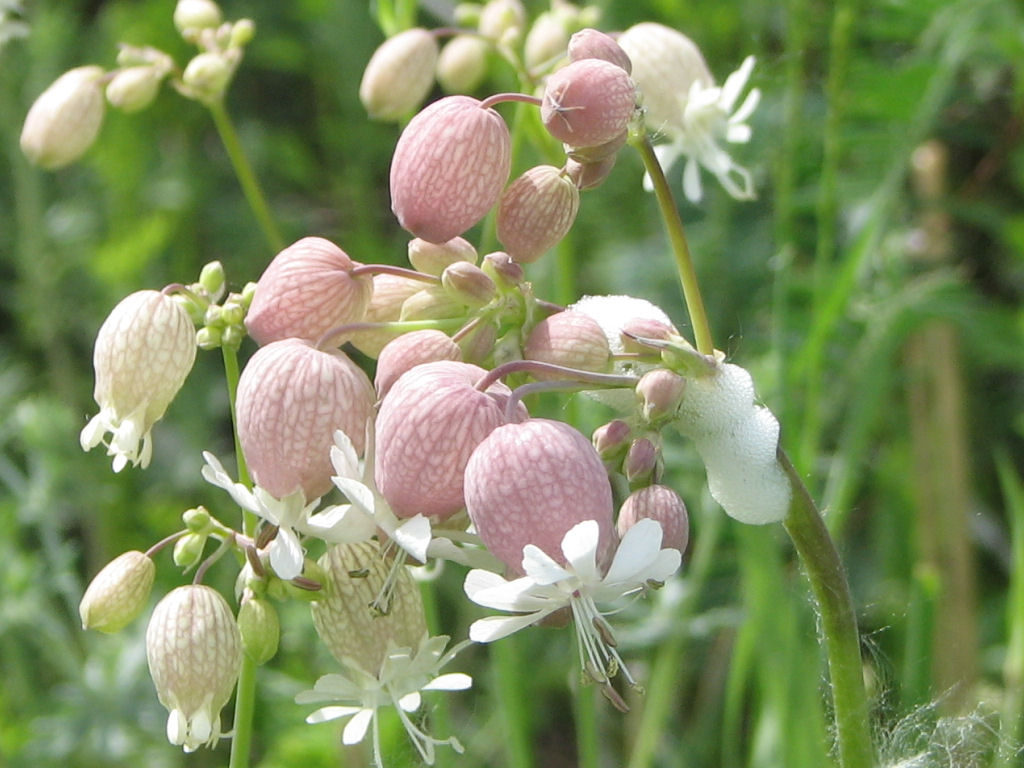
Bladder Campion is an erect perennial which grows from loose, chalky soil patches or from walls. It flowers in late spring and will not much larger than 50-60 cm. The glabrous stem makes few branches. The leaves, which grow opposite of each other, are usually decussate. With basal leaves being an exception, the Bladder Campion is generally stemless and has quite simple leaves, hairless and smooth in texture.
Although it belongs to the pink family (caryophyllaceae), the flowers are white and are made up of 5 petals, each having a deep indentation. The petal is therefore split into two distinct globules (parts) and hence an observer may count 10 petals on accident. The plant has 10 stamens, growing from the base of every petal. The filaments, usually green in color, can be pink or purple in color.
The calyx, rather than the flower, is perhaps the most visually impressive part of the plant. It is a large inflated structure, usually pale green or green yellow in color and has the shape of a balloon or bladder. A five-toothed rim at the mouth of the calyx gives the appearance of a crown. After the flower dies, the calyx withers but persists. It can be likened to a bowl with serpents. With time, the calyx browns but still maintains its bladder shape, protecting the developing seed capsule inside.
Photography by D. Gordon E. Robertson – Own work
CC BY-SA 3.0
https://commons.wikimedia.org/w/index.php?curid=8007825
Uses
The Bladder Campion’s shoots and leaves (while still young) are edible raw or cooked. The young leaves taste sweet and go very well in a salad. When the young shoots are cooked, they have a flavor similar to green peas, but with a slight bitterness. When consuming parts of this plant, it is better to harvest before the plant begins to flower.
Although not specifically mentioned for this species, it is quite likely that the root is used as a soap substitute for washing clothes. To obtain the soap, the plants roots can be simmered in hot water until the soaping agent, saponin, is released.