
The Blue Ridge Parkway is home to over a hundred species of trees, and throughout the year they put on a dramatic show. In spring, tulip trees and serviceberry produce vivid, eye-catching blooms. In fall, leaves burst into color. Flowering shrubs such as rhododendron, flame azalea, and mountain laurel put on a springtime show that rivals the tree’s fall display.
Forest Types
Beginning at the Parkway’s lowest elevations and climbing up to the highest, visitors will notice numerous transitions among a variety of forest types. At lower elevations, the oak-chestnut forest dominates Parkway lands. In remote, sheltered cove forests, you may find dozens of varieties of species, and some of the remaining virgin timber that was inaccessible to loggers earlier in the century. Higher up on the mountains, northern hardwood forests remind many people of those in New England. Beech, birch, or buckeye may dominate depending on other characteristics of the habitat. At the highest Parkway elevations, it is the spruce-fir forest that crowns the ridgetops and mountain peaks. In front of advancing glaciers, remnants of seeds normally germinating in Canadian forests found a habitat in which to grow.
Interspersed among these various forest types are some small, unique habitats, such as mountain bogs and heath balds. Many species of animals find their niche in these small pockets of habitat. Bog turtles and Gray’s Lilly thrive in mountain bogs. Sheltered, wet coves are excellent for finding a variety of salamanders, some of which are unique to the southern Appalachians. A hemlock cove is an excellent place to find populations of red squirrel. Black capped chickadees replace the Carolina chickadees as you climb up toward the spruce-fir forest.
Autumn Colors
On the Blue Ridge Parkway, trees enrich our lives throughout the year, but it is only in autumn that their vibrant foliage demands our attention. Dogwood, sourwood, and blackgum turn deep red in late September. Tulip-trees and hickories turn bright yellow, sassafras a vivid orange, and red maples a multi-colored brilliance. Finally, various oaks put on a dash of russet and maroon. Evergreen trees include Virginia pine, white pine, hemlock, spruce, and fir.
The intensity of the fall colors in a given year depends on weather conditions. A vivid autumn show requires bright, sunny days and nights that are cool but not freezing. If there is an early frost, many of the leaves may turn brown and drop before the rest have turned colors. But whatever the intensity, the autumn show is always a spectacular way of ending the summer and ushering in the winter.
| Common Name | Family | Fall Color |
|---|---|---|
| Alternate Lvd. Dogwood | Dogwood | Red |
| American Beech | Beech | Brown/Yellow |
| American Chestnut | Beech | Yellow |
| American Elm | Elm | Yellow |
| American Hornbeam | Birch | Orange/Red |
| American Plum | Rose | Yellow |
| Apple | Rose | Yellow |
| Big Tooth Aspen | Willow | Yellow |
| Bitternut Hickory | Walnut | Yellow |
| Black Birch | Birch | Yellow |
| Black Cherry | Rose | Red/Yellow |
| Black Gum | Dogwood | Red |
| Black Locust | Bean | Yellow |
| Black Oak | Beech | Red/Brown |
| Black Walnut | Walnut | Yellow |
| Black Willow | Willow | Yellow |
| Box Elder | Maple | Yellow/Red |
| Carolina Hemmlock | Pine | Evergreen |
| Catawba Rhododendron | Heath | Evergreen |
| Chestnut Oak | Beech | Yellow |
| Choke Cherry | Rose | Yellow |
| Common Winterberry | Holly | Yellow |
| Cucumber | Magnolia | Yellow |
| Eastern Hemlock | Pine | Evergreen |
| Eastern Red Cedar | Pine | Evergreen |
| Eastern White Pine | Pine | Evergreen |
| Flowering Dogwood | Dogwood | Red |
| Green Ash | Olive | Yellow |
| Hophornbeam | Birch | Yellow |
| Mockernut Hickory | Walnut | Yellow |
| Mountain Ash | Rose | Yellow |
| Mountain Laurel | Heath | Evergreen |
| Mountain Maple | Maple | Orange/Red |
| Mountain Winterberry | Holly | Yellow |
| Northern Oak | Beech | Red |
| Paw Paw | Annona | Yellow |
| Persimmon | Ebony | Yellow |
| Pignut Hickory | Walnut | Yellow |
| Pitch Pine | Pine | Evergreen |
| Red Maple | Maple | Yellow/Red/Orange |
| River Birch | Birch | Yellow |
| Royal Paulownia | Figwort | Yellow |
| Sassafras | Laurel | Yellow/Red/Orange |
| Scarlet Oak | Beech | Red |
| Serviceberry | Rose | Red/Yellow |
| Shagbark Hickory | Walnut | Yellow |
| Smooth Sumac | Cashew | Red |
| Sourwood | Heath | Red |
| Staghorn Sumac | Cashew | Red/Purple/Orange |
| Striped Maple | Maple | Yellow |
| Swamp Dogwood | Dogwood | Red |
| Sycamore | Sycamore | Brown |
| Table Mountain Pine | Pine | Evergreen |
| Tree of Heaven | Quassia | Yellow |
| Virginia Pine | Pine | Evergreen |
| White Ash | Olive | Purple/Yellow |
| White Oak | Beech | Red/Brown |
| White Walnut | Walnut | Yellow/Brown |
| Winged Sumac | Cashew | Red/Purple |
| Witch Hazel | Witch Hazel | Yellow |
| Yellow Birch | Birch | Yellow |
| Yellow Poplar | Magnolia | Yellow |
Why do the leaves change color?
In autumn, chlorophyll, the green coloring agent in leaves that makes photosynthesis possible, begins to decrease. As chlorophyll fades, other colors such as red, orange, and yellow appear.
Carotenes and xanthophylls are pigments that produce the lively yellows, golds, and oranges of autumn leaves. These pigments are present in summer but they are hidden by the green of chlorophyll. Only when chlorophyll production stops, do they show their presence.
The scarlet, rust, and purple leaves are caused by anthocyanin pigments. Unlike the carotenes and xanthophylls, these pigments are not already present in the leaves but are synthesized in the leaf after chlorophyll production stops. When chlorophyll production stops, so does the flow of water and glucose between the leaves and the tree. A layer of cells called the abscission layer develops to block the flow. Some glucose will be trapped inside the leaf and it will change to anthocyanin pigments with the help of certain weather conditions.
Tree Identification Book Resources
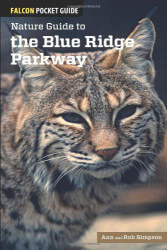
The stunning wildlife along the Blue Ridge Parkway attracts more than 14 million annual visitors from near and far for viewing and photographing opportunities. This information-packed, pocket-size field guide features more than 200 species of mammals, birds, insects, fish, wildflowers, mushrooms and more in a convenient, portable package.
Book Details Buy Now